See a hairstyle before the haircut
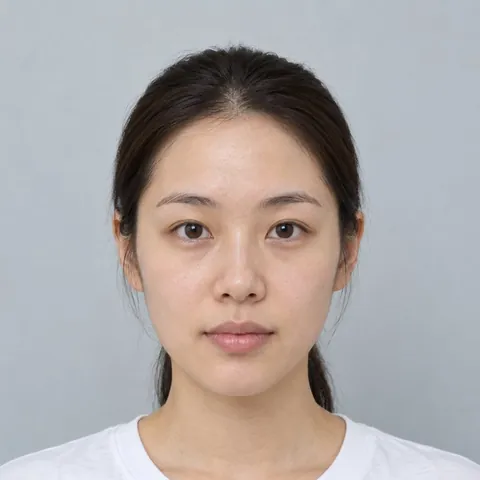
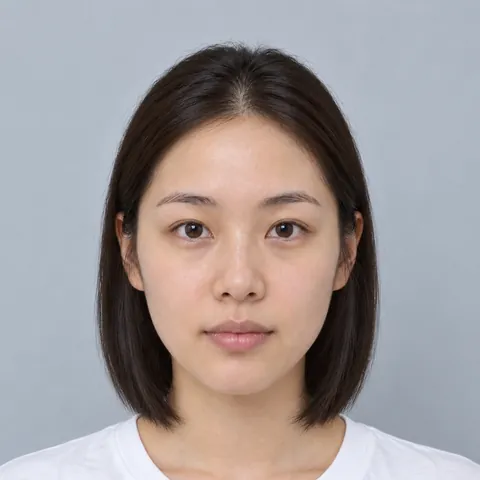
Existing demo images. A styling simulation, not a prediction. The report includes 6 optional AI renders; each is generated on request.
In this site's classifier these two reference sets are unusually close: the jaw ratio and the forehead ratio are identical in both. That leaves two numbers to separate them — length, which does most of the work, and the width of the lower jaw, which decides cases near the line. This page is about finding which side of that line your own measurements fall on.
The classifier compares four measured ratios against reference sets for six shapes and takes the nearest. For this pair, two of the four are identical, so the comparison rests on the other two. What each shape means in full, and what scale these figures are reported on, is on oblong face shape.
| What is compared | Oval | Oblong |
|---|---|---|
| Length ÷ width | 1.45 | 1.62 — differs by more than two tolerance units |
| Jaw ÷ cheekbone | 0.80 | 0.80 — identical, so it cancels out of this comparison |
| Forehead ÷ cheekbone | 0.88 | 0.88 — identical, same effect |
| Lower jaw ÷ cheekbone | 0.664 | 0.680 — differs by 0.8 of a tolerance unit |
| What decides between them | Length and lower jaw only | Jaw and forehead cannot move this line, but can hand the label to another shape |
| A leaning note is added when | Second-nearest distance − nearest distance < 0.8 | A gap between the top two, not a distance from either |
The two differences are not the same size. Length differs by 0.17 against a tolerance of 0.08, which is more than two tolerance units. The lower jaw ratio differs by 0.016 against a tolerance of 0.02, which is 0.8 of one. So length dominates the comparison — but the smaller term is not decorative. Holding length at 1.53 and moving only the lower jaw ratio, 0.672 returns oval and 0.680 returns oblong.
Because the jaw and forehead ratios are identical in both reference sets, they cancel out of this particular comparison entirely. The point at which your measurements stop being nearer oval and start being nearer oblong is set by length and the lower jaw ratio alone.
Running the classifier with the jaw ratio at 0.80 and the forehead ratio at 0.88, the switch came at a length ratio of about 1.55 when the lower jaw ratio was at oval's 0.664, and at about 1.52 when it was at oblong's 0.680. That spread is the whole reason the answer is a short range rather than a single number.
One thing this does not mean: that a different jaw or forehead ratio moves the line. It does not — those terms cancel. What a different jaw or forehead ratio can do is hand the label to a different shape altogether, since all six sets are in the comparison. With the jaw and forehead ratios at 0.86 and 0.94 the nearest set became square; at 0.74 and 0.82 it became diamond. In both cases the oval-versus-oblong question stopped applying rather than being answered somewhere else.
It does not mean the tool declined to answer. The nearest reference set is still the label. A leaning note is added when the second-nearest distance minus the nearest distance is less than 0.8 — a gap between the top two, not a distance from either.
The distinction matters because both distances can be large while the gap is small. At a length ratio of 1.53 with a lower jaw ratio of 0.672, the distances to oval and oblong are roughly 1.08 and 1.19: both well above 0.8, yet the gap between them is about 0.12, so the result carries the note.
What the note tells you is that the runner-up's distance from your measurements is less than 0.8 greater than the winner's. It is not a calibrated statement about how often a retake would flip the label, and a result without the note is not a guarantee of accuracy — it only means the gap did not fall under the threshold.
Start with the capture conditions rather than the conclusion. These ratios come from a two-dimensional image, and head position, camera distance and how clearly the edges of the face are visible all move them; oblong face shape goes through each. Two points are specific to this pair.
Repeat the measurement under consistent conditions — head square to the lens, similar distance, the edges of the face unobscured — and see whether the ratios hold. If they do and the result still carries a leaning note, that is the honest answer under this model: the two nearest reference sets have distances from your measurements that differ by less than 0.8.
This comparison uses length and lower jaw width to tell the two reference sets apart. It does not predict which hairstyle or frames will suit you.
If you want your face to appear shorter, that is a styling goal you can explore in the guides linked below. Neither label makes it necessary, and neither describes a problem to solve.
Or run the face shape tool and see your own ratios, and whether the runner-up falls within the leaning threshold.
In this site's reference values the two share their jaw ratio (0.80) and their forehead ratio (0.88), and differ on length — 1.45 for oval against 1.62 for oblong — plus a smaller difference in the lower jaw ratio, 0.664 against 0.680. Length carries most of the distinction; the lower jaw ratio decides cases near the crossover.
With the jaw ratio at 0.80 and the forehead ratio at 0.88, the switch came at about 1.55 when the lower jaw ratio was at oval's 0.664, and at about 1.52 when it was at oblong's 0.680. Because the jaw and forehead ratios are identical in both sets they cancel out of this comparison, so they do not move that line — but they can make a different shape win outright, since all six sets are compared at once.
The nearest reference set is still the label. The note is added when the second-nearest distance minus the nearest distance is less than 0.8 — a gap between the top two, not a distance from either, so both can be far away while the gap is small. It tells you the runner-up's distance from your measurements is less than 0.8 greater than the winner's; it is not a prediction about retaking the photo.
Tools use different reference values, take face width and face length at different landmarks, and some report rescaled figures rather than raw divisions, as this one does. Differences in measurement method or reference values can lead to different labels for the same photo. Results from two systems are not directly comparable.
Neither label ranks a face. The classifier assigns a shape name by comparing ratios; it does not assess health or attractiveness. The first three ratios are scaled so that the canonical mesh reference values match oval's corresponding values; this is a calibration choice, not a ranking of faces.
The free scanner reports all four ratios as numbers and tells you when a second reference set is close. Your photo stays on your device — nothing is uploaded.
Front-facing, unobstructed, evenly lit photos work best. Your photo is analysed on your phone or computer and is never uploaded.
Your shape is a starting point. The report uses your measured proportions to explain hair and frame choices.
US$12.99 US$6.99 46% off One-time payment. No subscription, no account.
Your report link and receipt go here (optional, checkout asks too)
Next: secure checkout by Waffo, charged in USD.
Checkout could not open just now. Leave your email and we will tell you the moment it is fixed.
Got it, thanks.
Not happy within 7 days? Email us for a full refund.
Explore a sample before you decide. Your own report uses your measurements; these examples show the format, not your result.
Existing demo images. A styling simulation, not a prediction. The report includes 6 optional AI renders; each is generated on request.
Softly rectangular frames with moderate lens depth and a frame width close to the face
Excerpt from the published sampleReshape the hair silhouette with crown lift, below-jaw length, and controlled sides.