See a hairstyle before the haircut
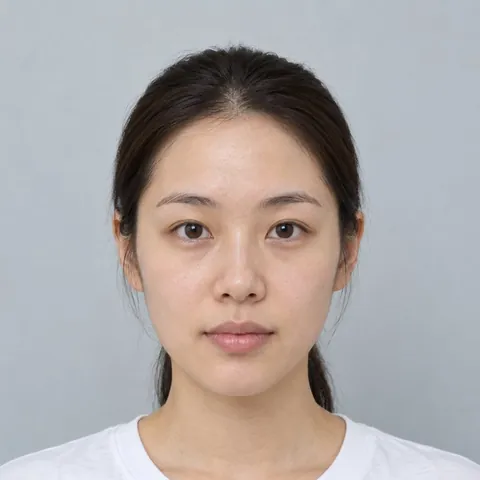
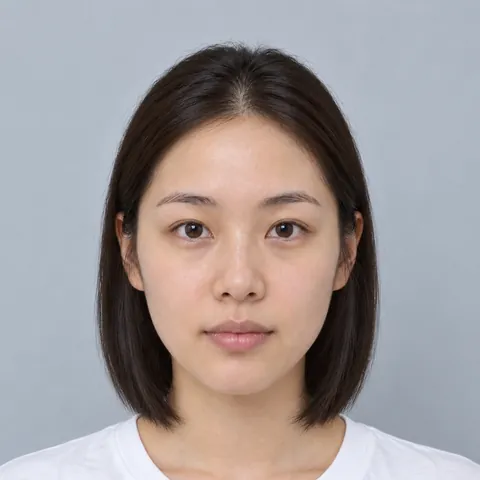
Existing demo images. A styling simulation, not a prediction. The report includes 6 optional AI renders; each is generated on request.
A complete report generated from one real scan, nothing cut. See exactly what you get before you pay.
The sample's measurements: score 84, oval face leaning oblong, strongest measure canthal tilt, weakest face length/width, season Soft Autumn. Your report rewrites every section from your own numbers.
How to read this sample: its coarse shape label leans oblong, but its measured length/width is 1.31. Styling follows the measured ratio, not the shape label alone.
Your strongest look is balanced and composed, with a compact outline that benefits from clean vertical styling.
Your features are broadly harmonious, with especially consistent eye tilt, strong overall symmetry, and a naturally balanced jaw. The main opportunity is proportion rather than correction: the measured outline reads wider and shorter than the coarse oblong label suggests, so the most flattering choices create vertical flow and keep side volume controlled.
Your eye corners follow a consistent gentle lift. This gives the upper face a calm, alert, and naturally polished expression.
The two sides of your face align closely in the features that shape first impressions. Small differences around the brows remain easy to refine through grooming.
Your jaw sits close to the common proportional range and flows smoothly into the lower face. It supports definition without dominating your other features.
The eye area governs expression and determines how open, focused, or relaxed the face appears. Your eye spacing is slightly open, while the outer corners carry a gentle and well-matched lift. Your eyes also occupy a little more visual space across the face, which makes them an immediate focal point. Pupil spacing is structural, while brow balance and the apparent eye opening are more responsive to styling. The available data does not show whether the eye opening should be visually increased or reduced, so spacing and tilt are the reliable guides here. So the goal is definition without making the eyes look farther apart.
→ Keep brow fronts softly defined and avoid leaving a large bare gap between them. Add subtle depth near the inner lash line, then use a short lifted outer liner rather than a long horizontal wing. Groom each brow separately to improve their small asymmetry instead of forcing identical shapes.
The nose anchors the centre of the face and guides how the eyes and mouth connect. Your nose reads slightly narrow in relation to the mouth, while the middle third, from the brows to the base of the nose, carries a little more visual length than the surrounding sections. This creates a refined central line rather than a heavy one. So the nose works best as a quiet bridge between stronger features.
→ Use a soft, diffused highlight along the centre rather than sharp contour lines. Keep side shading minimal and blended. Avoid extending nose contour far into the brows, which would make the middle section look longer.
The mouth governs expression in the lower face and affects how broad or compact that area appears. Your lips read slightly more prominent in their internal balance, and the mouth has enough width to contrast with the narrower nose. This gives the lower face presence without overwhelming the jaw. So the lips need polish more than enlargement.
→ Define the cupid’s bow softly and keep lip liner close to the natural edge. Concentrate colour through the centre, then blur the outer corners slightly to avoid adding horizontal width. Choose satin or softly blurred finishes over a sharply extended outline.
The jaw controls the transition from the cheeks to the chin and strongly influences perceived face shape. Your jaw proportion sits close to the common range, with a clean relationship to the wider facial structure. It does not need extra width or aggressive narrowing. So the jaw should support the face rather than become the styling focus.
→ Keep contour light and place it near the outer jaw corners rather than drawing a broad line underneath the entire jaw. Direct blush upward and slightly inward. Avoid hairstyles that end with bulky volume directly beside the jaw.
The outline governs whether the face reads long, compact, broad, or narrow at first glance. Although the nearest shape label leans oblong, the measured proportion reads noticeably wider and shorter. The upper face also carries slightly more horizontal presence than vertical height. The label is only a coarse prototype, so the measured outline should lead your styling decisions. So your highest-leverage move is to create vertical flow while reducing visual width at the sides.
→ Add controlled height at the crown and choose lengths that continue below the jaw. Keep temple and cheek-level volume close to the head. Use vertical parts, longer front pieces, and frames with visible lens depth rather than wide, shallow shapes.
A reference band is the range a camera commonly measures across most faces — not a target to reach. Sitting outside one does not mean it looks worse.
You gave us one front-facing photo, and some things simply cannot be measured from it. Rather than invent a number, we say plainly what we did not measure — so you know how far to trust the numbers we did give.
Existing demo images. A styling simulation, not a prediction. The report includes 6 optional AI renders; each is generated on request.
Softly rectangular frames with moderate lens depth and a frame width close to the face
Excerpt from the published sampleReshape the hair silhouette with crown lift, below-jaw length, and controlled sides.
Choose softly angled brows with tidy inner edges and a gently lifted tail. Correct each side through precise grooming rather than making both brows heavier.
Place blush high and slightly inward, then blend upward instead of sweeping it broadly across the cheeks. Keep the centre of the face softly illuminated. Use short lifted liner and avoid extending lip colour or eye makeup too far sideways.
Keep the camera near eye level and step back rather than using a close wide-angle view. Use soft frontal light with gentle central emphasis. Choose a portrait crop with space above the crown and avoid strong side lighting that exaggerates facial width.
For entertainment, your balanced eye direction and steady jaw can read as composed, observant, and self-possessed. The slightly open eye spacing adds an approachable quality, while the compact outline gives the face a grounded presence. These are visual impressions, not statements about personality or destiny.
Entertainment only. This section is not a prediction and does not assess fortune, character, or health.
Your colouring is moderately warm, close to the middle in depth, and clearly softened rather than bright. That combination places you in Soft Autumn, where muted warmth harmonises with the skin, hair, brows, and eyes without creating harsh separation. Gentle tonal transitions also support the clean vertical styling recommended for your compact outline.
Wear: Choose olive, moss, muted teal, warm taupe, camel, cocoa, dusty terracotta, soft peach, and creamy ivory. Use low-contrast vertical colour columns, such as a cocoa jacket over a warm taupe top, to reinforce length without looking severe.
Avoid: Limit icy pastels, optic white, blue-based fuchsia, neon brights, and stark black-and-white contrast. Very clear colours can overpower your naturally softened colouring, while broad high-contrast blocks can emphasise width.
Makeup: Try muted peach or terracotta blush, soft bronze or olive-brown eyeshadow, brown liner, and rosewood or cinnamon lips. Keep finishes satin or softly diffused rather than icy, glossy, or highly reflective.
You sit very close to the True Autumn border — a photo in different light could well land there instead. Try both palettes and see which one does more for you.
Why here: This directly counters the strongest proportional deviation and keeps every other styling choice moving in the same vertical direction.
Why here: The right frame adds structure around the eyes without extending the face sideways.
Why here: This redirects attention vertically while preserving the natural jaw balance.
Why here: A cleaner inner brow frame reduces the impression of extra space between the eyes and improves visible symmetry.
Why here: This reduces close-camera widening and presents the underlying proportions more faithfully.
Your face does not need competing corrections. Keep the strategy simple: preserve the balanced features, create vertical flow, and let muted warmth provide the finish.
US$12.99 US$6.99 46% off
Free scan, nothing uploaded. The full report is US$6.99 once, full refund within 7 days if you are not happy.
Generated from the proportions measured in your photo. Styling reference and entertainment only, not medical or cosmetic-surgery advice.