See a hairstyle before the haircut
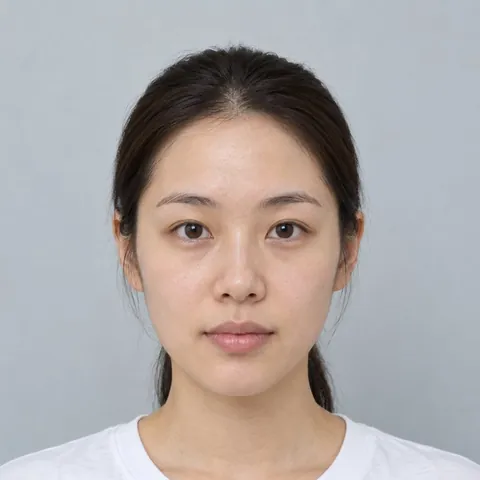
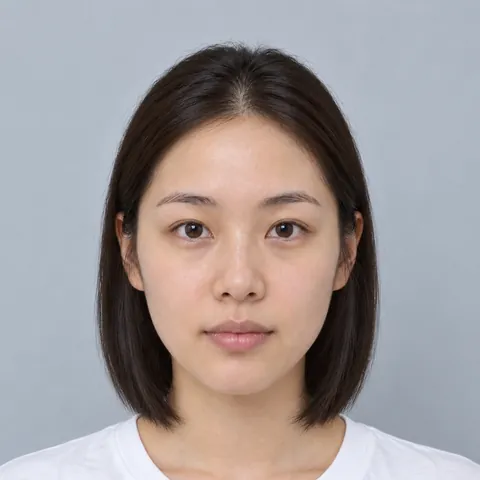
Existing demo images. A styling simulation, not a prediction. The report includes 6 optional AI renders; each is generated on request.
An oblong face is long relative to its width. On this site that is a label assigned by comparing four ratios measured from your photo against a set of reference shapes, and taking the nearest. This page sets out what those reference values are, what scale they are reported on, what the name does and does not cover, and which things change the measurement without changing your face.
The classifier holds one set of reference ratios per shape and picks whichever is closest to yours across all four at once. These are comparison points, not averages of people with that face shape, and not a definition anyone else is obliged to use.
For oblong the reference values are: length over width 1.62, jaw over cheekbone 0.80, forehead over cheekbone 0.88, and lower jaw over cheekbone 0.680.
Set those beside the oval reference values and the structure of the comparison shows. The jaw ratio is the same in both at 0.80, and so is the forehead ratio at 0.88. What differs is length — 1.62 against oval's 1.45 — and, by much less, the lower jaw ratio, 0.680 against 0.664. Length carries most of the separation, and the lower jaw ratio still participates: with the other ratios held fixed, moving it alone across that small range is enough to change which of the two labels a borderline face receives.
| What is compared | Oblong reference value | What it means here |
|---|---|---|
| Length ÷ width | 1.62 | Long relative to width. The largest gap from oval's 1.45 |
| Jaw ÷ cheekbone | 0.80 | Rescaled jaw-width ratio; identical to oval |
| Forehead ÷ cheekbone | 0.88 | Rescaled forehead-width ratio; identical to oval |
| Lower jaw ÷ cheekbone | 0.680 | Against oval's 0.664. Small, but enough to decide the label near the line |
| Scale of the first three | Three separate scale factors | They map the canonical mesh references to length 1.45, jaw 0.80 and forehead 0.88. Lower jaw is unscaled |
| How the label is chosen | Nearest of six reference sets | All four ratios at once. A leaning note is added when the top two distances differ by less than 0.8 |
This matters before you reach for a ruler. The figures above are not raw divisions, and they are not on one shared scale. The first three mesh ratios use separate scale factors: length over width × (1.45 / 1.152), jaw over cheekbone × (0.80 / 0.775), and forehead over cheekbone × (0.88 / 0.670). These map the canonical mesh reference values used in the code to 1.45, 0.80 and 0.88 respectively. The lower jaw ratio is unscaled.
The value 1.152 is the canonical mesh reference ratio used in the code, not a promised ruler measurement. Measurements taken by hand with different endpoints cannot be compared directly with these classifier values. So use these figures to understand which reference set you are nearest, not as targets to reproduce with a ruler. The hand method, with its own caveats, is set out in how to tell your face shape.
Where the line between oblong and oval falls, and what happens when you land near it, is worked through on oblong vs oval face shape.
These terms overlap, and usage varies between sources. Here, oblong is the name of a classifier category defined by the ratios above. Long face is a broader description of appearance rather than a measured category. Rectangle appears in some styling systems, where it can carry the extra sense of a long face with a more angular outline.
Worth checking which sense a page means before following it, since the two can point in different directions. This site has no rectangle category: a long face with a wide, angular jaw is compared against the square reference set as well as the oblong one, and whichever is nearer across all four ratios becomes the label.
It compares four width and length ratios. It does not measure jaw angle, the curve of the jawline, chin shape, or how far the cheekbones project. Those features are on your face; they are not what these ratios encode. A description that turns on jaw angle rather than jaw width is describing something the numbers here do not capture.
It also compares against all six reference sets at once, not against oval alone. Each of the others is a different combination rather than a single trait: heart pairs a jaw ratio of 0.76 with a forehead ratio of 0.96, diamond pairs the same 0.76 jaw with a much narrower 0.80 forehead, and round and square differ from each other mainly in jaw width at a shorter length. So a single word like "narrow jaw" does not identify a shape on its own.
Every ratio here comes from a two-dimensional photograph, so the numbers describe the image as much as the face in it. Three things are worth controlling before treating a result as settled.
These are distances between estimated mesh landmarks, with separate scale factors applied to the first three ratios; they are not direct measurements of the bone beneath. Other measurement traditions use different endpoints — some facial measurement systems work from the nasion — so a length taken elsewhere is not directly comparable to this one.
A shape label is a description, not a problem statement. Nothing about an oblong face needs correcting, and the classifier makes no claim about health or attractiveness. If you want to explore ways of making your face appear shorter, the styling guides below offer ideas. That goal is a personal preference; these ratios do not predict the effect of a particular cut or frame.
Or run the face shape tool and read your own ratios rather than estimating them in a mirror.
A face that is long relative to its width. On this site it is a classifier label: four ratios measured from your photo are compared against reference sets for six shapes, and oblong is the label when its set is nearest. The oblong reference values are a length ratio of 1.62, a jaw ratio of 0.80, a forehead ratio of 0.88 and a lower jaw ratio of 0.680.
Not directly. The first three classifier ratios use separate scale factors, and the lower jaw ratio is unscaled. A ruler measurement taken with different endpoints does not reproduce these inputs, and does not establish which reference set is nearest.
The terms overlap but usage varies. Oblong is the name of a measured category here; long face is a broader description of appearance; rectangle appears in some styling systems and can imply a long face with a more angular outline. This site has no rectangle category — such a face is compared against the square reference set as well as the oblong one.
Not in these reference values. The oblong jaw ratio is 0.80 on this site's rescaled measurement scale, the same value as oval's. Shapes with a notably narrower jaw ratio of 0.76 are heart and diamond, and those two are told apart by the forehead ratio — 0.96 for heart against 0.80 for diamond. No single trait identifies a shape on its own.
The ratios are measured from a two-dimensional image, so head position, camera distance and how clearly the edges of the face are visible all affect them. The scanner levels the eye line, which compensates for in-plane roll, but it screens rather than corrects for turning and tilting. If two results differ, check the capture conditions and measure again under consistent ones.
The free scanner reports your four ratios as numbers and names the closest reference shape. Your photo stays on your device — nothing is uploaded.
Front-facing, unobstructed, evenly lit photos work best. Your photo is analysed on your phone or computer and is never uploaded.
Your shape is a starting point. The report uses your measured proportions to explain hair and frame choices.
US$12.99 US$6.99 46% off One-time payment. No subscription, no account.
Your report link and receipt go here (optional, checkout asks too)
Next: secure checkout by Waffo, charged in USD.
Checkout could not open just now. Leave your email and we will tell you the moment it is fixed.
Got it, thanks.
Not happy within 7 days? Email us for a full refund.
Explore a sample before you decide. Your own report uses your measurements; these examples show the format, not your result.
Existing demo images. A styling simulation, not a prediction. The report includes 6 optional AI renders; each is generated on request.
Softly rectangular frames with moderate lens depth and a frame width close to the face
Excerpt from the published sampleReshape the hair silhouette with crown lift, below-jaw length, and controlled sides.