See a hairstyle before the haircut
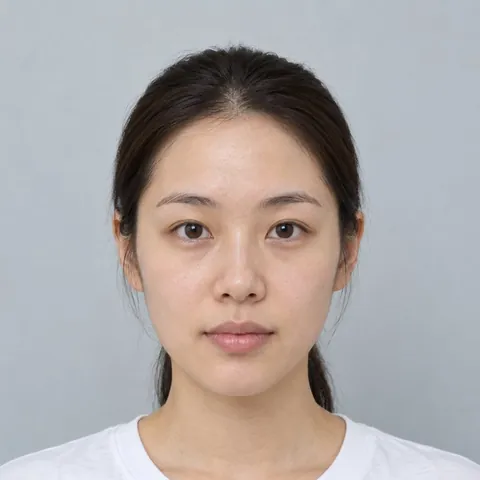
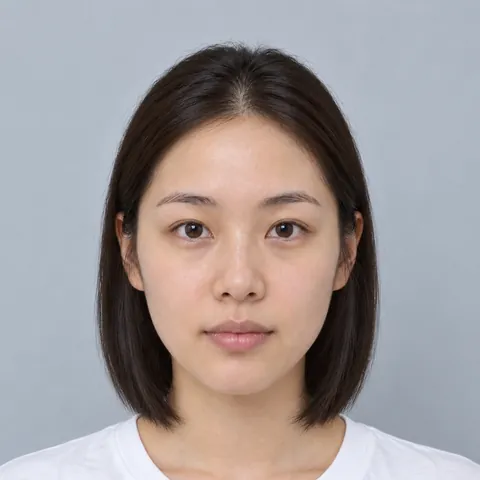
Existing demo images. A styling simulation, not a prediction. The report includes 6 optional AI renders; each is generated on request.
A square face has a jaw nearly as wide as the cheekbones and an outline with corners. The jaw is the feature, and most bad advice tells you to hide it. Better advice softens the lines around it and leaves the structure alone. Here is what that means in cuts, for women and for men.
Face length divided by cheekbone width sits around 1.42, close to oval. Jaw width divided by cheekbone width is about 0.85, against 0.80 for oval: the jaw is nearly as wide as the cheekbones. Forehead over cheekbone is about 0.90, also slightly wider than oval. So all three widths are close to each other, and the outline runs nearly straight down from temple to jaw before turning a visible corner.
That corner is the whole story. The proportions are not far from oval; what makes the face read as square is the angle of the jaw and the straightness of the sides. A haircut cannot change either, and it should not try to hide the jaw, because a defined jaw is one of the features people pay for. What a cut can do is put curves and diagonals near the straight lines so the eye reads the face as structured rather than boxed.
Square is often confused with round, which has the same wide jaw with a curve instead of a corner, and with oblong, which shares the straight sides but runs much longer. The face shape tool measures the ratios and the jaw angle and reports which shape you are leaning toward.
Soften, do not hide. Waves, layers that curve inward, side parts and side-swept fringes all add curves and diagonals that offset the corners. Blunt horizontal lines, especially at the jaw or across the forehead, add more straight edges to a face that already has plenty. Hiding the jaw behind a wall of hair removes the feature instead of balancing it.
| Cut | What it is | What it fixes |
|---|---|---|
| Soft waves, side part | Loose waves, not tight curls | The most reliable answer: curves next to straight lines, and a diagonal across the forehead |
| Layers curving in at the jaw | From the cheekbone, ends turning inward | Draws a soft line around the corner without covering it. Ask for point-cut ends, not blunt |
| Curtain fringe | Middle-parted, swept out both ways | Two diagonals across the forehead and no horizontal line at all |
| Long wavy lob | Ends below the jaw, waved or flicked | Keeps the horizontal away from the jaw; the wave keeps the sides from hanging straight |
| Side-swept fringe with length | Long fringe plus a side part | Every line on the face ends up diagonal. Especially good with hair tucked on one side |
| Shoulder-length shag | Layered and textured all the way down | Irregular ends disrupt the straight sides; volume sits around the face, not on top |
| Loose low updo, pieces out | Low and loose, soft pieces at the temples | A tight sleek updo exposes every corner at once — this does the opposite |
| Round-layered pixie | Longer on top, softly layered sides | Short hair works if the cut itself is round. A sharp-edged crop makes the outline sharper |
The most reliable answer. Waves put curves next to straight lines; a side part adds a diagonal across the forehead so the top of the face does not read as a flat edge. Keep the waves loose rather than tight.
Face-framing layers beginning at the cheekbone, with the ends curving inward at the jaw, draw a soft line around the corner without covering it. Ask for the ends to be point-cut or razored rather than blunt.
Parted in the middle and swept out to the sides, a curtain fringe breaks up the forehead with two diagonals. It is the fringe for a square face because it adds no horizontal line.
A long bob that ends below the jaw with the ends waved or flicked. The length keeps the horizontal line away from the jaw and the wave keeps the sides from running straight. Avoid a lob that stops level with the jaw.
A long fringe swept across the forehead pairs with a side part to keep every line on the face diagonal. Works especially well with hair worn tucked on one side.
A layered, textured cut with movement all the way down. The irregular ends disrupt the straight sides, and the volume sits around the face rather than on top of it.
If you put your hair up, keep it loose and low, and leave soft pieces out at the temples and in front of the ears. A tight, sleek updo exposes every corner at once.
Short hair works on a square face if the shape of the cut is round: longer on top with the sides and fringe softly layered around the face. A cropped pixie with sharp edges makes the outline sharper.
A square jaw is close to the reference for men's faces, so the men's advice is lighter than for round or oblong: keep the jaw, avoid squaring off the top to match.
Short, textured top with a slight fringe brought forward and left uneven at the edges. The texture adds movement to the top of a face whose bottom is already defined. Pair with a low taper rather than a high skin fade.
Two to three inches on top swept across to one side. The diagonal on top balances the horizontal jaw. The classic barber cut for this shape, and it works in every setting.
Three to five inches worn loose, pushed back or to the side with some wave or texture left in. Movement on top softens the straight sides without hiding the jaw.
Whatever the top, keep the sides tapered so the outline of the head curves into the face. Sides shaved flat to the skin make the head as square as the jaw.
A short beard that follows the jawline and is trimmed close at the corners keeps the definition and softens the angle a little. A long or squared-off beard adds width and more corners.
Four inches or more pushed back with the fingers rather than combed flat. The looseness matters: a slicked, flat top adds a hard line across the forehead.
How to measure the three ratios yourself is in how to tell your face shape. For glasses, the same principle holds: round or oval frames offset the angles; heavy square frames repeat them.
Anything that puts curves and diagonals near the jaw. For women, soft waves with a side part, or layers that start at the cheekbone and curve inward at the jaw; for men, a textured top with some length swept to one side, and sides that are tapered rather than shaved flat. The reason is the ratio: a square face has a jaw nearly as wide as its cheekbones (about 0.85 against a reference of 0.80) with an angular outline, so the cut needs to break the straight lines, not add more.
A blunt bob that ends level with the jaw, yes: it draws a horizontal line exactly along the widest, straightest part of the face and turns the jaw into a box. A bob that ends above or below the jaw with the ends curving inward is fine, and a longer, wavier bob is good.
Side-swept and curtain fringes, yes: they add a diagonal that offsets the horizontal jaw. A heavy, straight-across fringe is the one to avoid, because it adds a second horizontal line at the top and makes the face read as a block.
A square jaw is an asset for men, so the aim is balance rather than disguise. Textured crops, a side part with the top swept across, and medium length with some movement all work. A high skin fade with a flat top is the combination to skip: it squares off the top to match the bottom. A short beard that follows the jaw and is trimmed close at the corners keeps the definition without adding width.
Both have a jaw nearly as wide as the cheekbones. The difference is the angle: square has a visible corner at the jaw, round has a curve. Measure jaw width divided by cheekbone width; square sits near 0.85 with a straight jawline, round near 0.82 with a rounded one. The tool measures both and reports which you are leaning toward.
The two shapes share a wide jaw and differ in the angle. The scanner measures your jaw-to-cheekbone ratio and the jawline from a photo and tells you which you are closest to.
Front-facing, unobstructed, evenly lit photos work best. Your photo is analysed on your phone or computer and is never uploaded.
Your shape is a starting point. The report uses your measured proportions to explain hair and frame choices.
US$12.99 US$6.99 46% off One-time payment. No subscription, no account.
Your report link and receipt go here (optional, checkout asks too)
Next: secure checkout by Waffo, charged in USD.
Checkout could not open just now. Leave your email and we will tell you the moment it is fixed.
Got it, thanks.
Not happy within 7 days? Email us for a full refund.
Explore a sample before you decide. Your own report uses your measurements; these examples show the format, not your result.
Existing demo images. A styling simulation, not a prediction. The report includes 6 optional AI renders; each is generated on request.
Softly rectangular frames with moderate lens depth and a frame width close to the face
Excerpt from the published sampleReshape the hair silhouette with crown lift, below-jaw length, and controlled sides.