See a hairstyle before the haircut
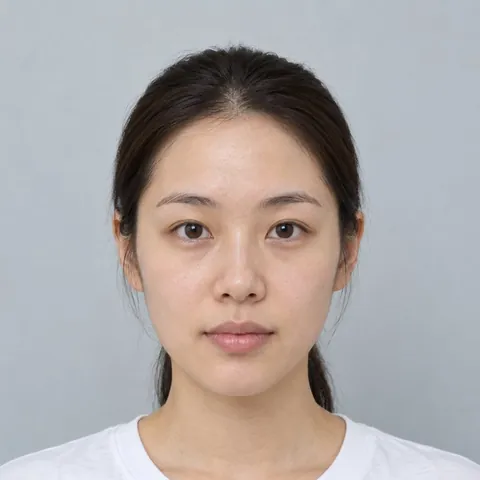

Existing demo images. A styling simulation, not a prediction. The report includes 6 optional AI renders; each is generated on request.
Oval is the shape every other guide uses as the reference, which is why the answer for oval itself is mostly a yes. The useful part is knowing where the yes stops: which extremes of size and shape tip the balance, and how to use a frame to add character rather than correction.
Face length divided by face width sits around 1.45; jaw width over cheekbone width about 0.80; forehead over cheekbone about 0.88. The cheekbones are the widest point and the outline tapers gently in both directions. There is no shortage of length, width, or angle to make up for.
For glasses that means the frame has no corrective job. On a round face the frame supplies angles; on an oblong face it supplies depth; on an oval face it only has to avoid breaking a balance that already exists. That gives you the widest choice of any shape, and it also means the frame can be chosen for what it adds — character, colour, a period reference — rather than for what it fixes.
Oval is a wide band. If the face shape tool says oval leaning round or oval leaning oblong, the advice for those shapes starts to apply at the edges.
Keep the proportion, add character. A frame as wide as the face, with a depth in proportion to its width, keeps the balance. Within that, shape is nearly free: angular frames add a little structure, round frames add softness, and both look right. The only real mistakes are frames that are much too big or much too small.
| Frame | What it is | What it does here |
|---|---|---|
| Square, softened corners | A little structure, none of the boxiness | The safest first pair — oval needs no correcting, so this just adds crispness |
| Rectangular | Wider than deep, clear corners | A horizontal line across the eyes that reads as crisp, not corrective. Keep depth moderate |
| Wayfarer | Top-heavy trapezoid, classic proportions | On an oval face it simply looks like a wayfarer — pick the size by face width |
| Round | Thin metal or thicker acetate | Oval is the shape that carries round frames; keep the lens off the cheekbones |
| Browline | Heavy top bar, lighter bottom | Definition at the brow without shifting the balance anywhere else |
| Cat-eye | Soft or angular, moderate upsweep | Both versions work; only the very large exaggerated ones fight the face |
| Geometric | Hexagonal or octagonal | Interest without committing to angular or round — this face needs no statement |
| Aviator | Teardrop or squared navigator | One of the few faces where the classic teardrop, which most struggle with, looks right |
The safest first pair. A little structure from the corners, none of the boxiness of a hard square. As wide as the face, moderate depth.
Wider than deep, clear corners. Adds a horizontal line across the eyes that reads as crisp rather than corrective. Keep the depth moderate; very shallow rectangles can look severe on a face with soft proportions.
The top-heavy trapezoid works on almost every shape, and on an oval face it simply looks like a wayfarer. Choose the size by face width; the classic proportions are right as they are.
Oval is the shape that wears round frames well. Thin metal rounds read as intellectual; thicker acetate rounds read as retro. Keep the lens diameter moderate so the frame does not cover the cheekbones.
A heavy top bar with a lighter bottom. On an oval face it adds definition at the brow without changing the balance elsewhere. A good choice if you want a frame with presence.
For women, both the soft and the angular versions work. A moderate upsweep lifts the face slightly; a sharper point adds edge. Avoid only the very large, very exaggerated versions.
Multi-sided frames add interest without committing to angular or round. They suit an oval face because the face does not need the frame to make a strong statement in either direction.
Both the teardrop and the squared navigator work. This is one of the few shapes where the classic teardrop aviator, which most faces struggle with, looks right.
Both stores ship within the US and let you filter frames by shape, so you can go straight to the styles recommended above.
Amazon.The widest range of frames at every price, with reviews and free returns on most listings. Start from the shapes recommended above and filter by frame shape. Search frames on Amazon →
Disclosure: links in this box are affiliate links. If you buy through them we may earn a commission at no extra cost to you. As an Amazon Associate, faceanalyzer.org earns from qualifying purchases. It does not change which shapes we recommend.
The same freedom applies with one limit: size. Sunglasses run larger than eyeglasses, and very large lenses that cover the cheekbones are the one thing that changes an oval face's proportions.
Teardrop or navigator, both work. The classic teardrop is at its best on this shape.
Works at every size up to the point where the frame is much wider than the face.
Fine in moderate sizes. Very large round lenses are the one round-frame risk for an oval face.
For women, from soft to sharp. Pick by taste.
Fine. Oversized square sunglasses are wearable here as long as the width is not far beyond the face.
Only the extremes: enormous shield or oversized styles that cover the cheekbones, and tiny narrow lenses that make the face look longer than it is.
The hair advice for this shape follows the same idea: keep the face visible, do not stack height on top. The oval face hairstyles guide covers it. How to measure the ratios by hand is in how to tell your face shape.
Most shapes, which is the point of being oval: the proportions are already close to the reference (length about 1.45 times width, jaw and forehead both slightly narrower than the cheekbones), so there is nothing to correct. The frames that look best add a little structure without changing the balance: square or rectangular frames with softened corners, wayfarers, browlines, and moderately sized geometric shapes. If you want one safe first pair, a slightly angular frame that is as wide as your face is hard to get wrong.
Only the extremes. Frames much wider than the face throw the balance off; very deep, oversized frames cover the cheekbones and make the face read shorter; very narrow frames make it read longer. Everything in the middle works. The other thing to avoid is a frame so bland it adds nothing; an oval face can carry a frame with some character.
Yes. Oval is the shape that can wear round frames well, because the face has enough structure of its own that a curved frame does not make it look soft. Keep the size moderate; very large round frames start to shorten the face.
Nearly all of them, including the two styles other shapes struggle with: round lenses and teardrop aviators. Wayfarers, squares and cat-eyes also work. The only real limit is size; oversized sunglasses that cover the cheekbones tip an oval face toward round.
Measure face length divided by width at the cheekbones. Oval sits near 1.45; oblong runs about 1.6 and above. If you land between the two, the tool will tell you which way you are leaning, and the oblong advice about deeper frames starts to apply.
The scanner measures your length-to-width, jaw and forehead ratios from one photo and tells you which shape you are closest to, and which one you are leaning toward.
Front-facing, unobstructed, evenly lit photos work best. Your photo is analysed on your phone or computer and is never uploaded.
Your shape is a starting point. The report uses your measured proportions to explain hair and frame choices.
US$12.99 US$6.99 46% off One-time payment. No subscription, no account.
Your report link and receipt go here (optional, checkout asks too)
Next: secure checkout by Waffo, charged in USD.
Checkout could not open just now. Leave your email and we will tell you the moment it is fixed.
Got it, thanks.
Not happy within 7 days? Email us for a full refund.
Explore a sample before you decide. Your own report uses your measurements; these examples show the format, not your result.
Existing demo images. A styling simulation, not a prediction. The report includes 6 optional AI renders; each is generated on request.
Softly rectangular frames with moderate lens depth and a frame width close to the face
Excerpt from the published sampleReshape the hair silhouette with crown lift, below-jaw length, and controlled sides.